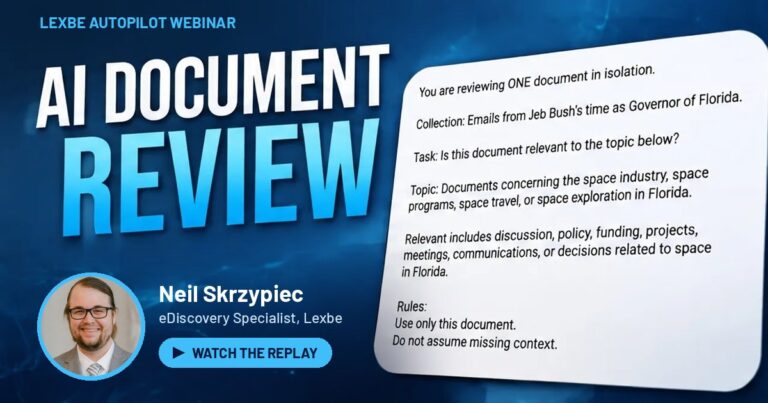
Live session shows litigation teams how Lexbe AutoPilot’s document-level AI can cut first-level review time by up to 70% without sacrificing defensibility
Lexbe’s September 23, 2026 webinar, Lexbe AutoPilot: Next-Gen Document Review, showed litigation teams how stateless generative AI automates first-level responsiveness review and privilege and confidentiality triage, and how to keep that workflow defensible in regulated environments. The session also covered RFP determinations, document classification, and case timelining, with practical prompts, real outputs, and a worked ROI example. Watch the full replay on this page.
AUSTIN, TX — September 2026 — Lexbe, a leader in GenAI-powered eDiscovery and digital forensics, held its live educational webinar, “Lexbe AutoPilot: Next-Gen Document Review,” as the next installment in its ongoing eDiscovery Webinar Series, a free session open to litigators, paralegals, litigation support professionals, and eDiscovery practitioners.
The webinar addressed a challenge every litigation team recognizes: data volumes keep rising, review timelines keep shrinking, and stakeholders increasingly expect a defensible answer to why this document was flagged, and why wasn’t that one. Lexbe AutoPilot, the company’s stateless GenAI engine, is built to answer that question at scale by reviewing documents one at a time, applying a consistent prompt, and returning a rationale with every call.
“Review time is too often spent on basic comprehension instead of legal judgment. AutoPilot takes on the comprehension work, summarizing, tagging, and flagging, so reviewers can spend their time where it actually matters: making the call.” — Neil Skrzypiec, eDiscovery Specialist, Lexbe
How to Reduce Document Review Time with GenAI
Legal teams cut review time by handing the first pass to stateless GenAI: summarizing documents, coding for responsiveness, and flagging privilege, so attorneys spend their hours on judgment calls instead of comprehension. The session walked through prompts and real outputs across six core eDiscovery use cases:
- Document Summaries — plain-language summaries and key-fact extraction for faster comprehension in early case assessment and witness prep
- First-Level Responsiveness Review — responsiveness determinations with a confidence score and stated rationale for every document
- RFP Determinations — automatic mapping of documents to the specific Requests for Production they satisfy
- Privilege & Confidentiality Triage — Attorney-Client and Work Product flagging to prioritize high-risk documents for counsel review
- Classification & Routing — automatic sorting by document type, business function, and intent for smarter batching
- Case Timelining — extraction of dated events, decisions, and actors that can be aggregated into a full case chronology
The session also covered how legal teams can validate GenAI review output before relying on it in production. It included how to read precision and recall, how to build a statistically valid control set, and how to run elusion testing on the documents AutoPilot did not flag.
Why It Matters
Using a worked example modeled on a 100,000-document first-level review, Lexbe shows how a linear, fully-manual review (roughly 2,000 reviewer hours at a $60/hour blended rate, or about $120,000 in labor) compares to an AutoPilot-assisted review of the same collection — reducing first-level labor to roughly 600 reviewer hours and an estimated ~$48,500 in combined review and platform cost, a savings of about 70% in review hours. Actual results vary by matter, collection composition, and confidence thresholds chosen.
Frequently Asked Questions
What is stateless GenAI, and how is it different from contextual AI? Stateless GenAI analyzes one document at a time and does not retain memory of prior documents in the collection. That makes it well-suited for consistent, high-scale tasks like tagging, summarizing, and privilege triage. Contextual AI, by contrast, works across documents to build narratives, chronologies, and strategy memos. Lexbe AutoPilot uses a stateless approach, and Lexbe recommends layering it with contextual tools for narrative-level work.
Who is this webinar for? Litigators, paralegals, litigation support professionals, and eDiscovery practitioners who handle first-level document review, privilege logs, RFP responses, or case timelines will get the most from these sessions.
Can I watch the replay? Yes. The full replay is free to watch on this page, with chapters so you can jump straight to the topics you need.
Does Lexbe AutoPilot replace human reviewers? No. AutoPilot is designed as a first-pass review layer. Responsiveness, privilege, and issue-tagging judgment calls remain with reviewing attorneys; AutoPilot’s role is to reduce the comprehension work and prioritize what humans review first.
How is AutoPilot’s accuracy measured? Through precision (of what AutoPilot flagged, how much was correct) and recall (of what was truly responsive, how much AutoPilot found), validated against a human-coded control set drawn before AutoPilot runs, with elusion testing on the documents it did not flag.
How much time can GenAI save on document review? Lexbe AutoPilot can reduce first-level review time by up to 70%, based on Lexbe’s internal testing. Actual savings depend on the size of the collection, the mix of document types, and how much of the review is first-pass responsiveness and privilege coding rather than attorney judgment calls.
Is AI-assisted document review defensible? Yes, when the process is transparent and validated. Courts have accepted technology-assisted review for more than a decade, and the same principles apply to GenAI: measure precision and recall against a human-coded control set, run elusion testing on documents the AI did not flag, and keep attorneys responsible for final responsiveness and privilege calls. AutoPilot provides a confidence score and a stated rationale for every document, which supports that documentation.
About Lexbe
Founded in 2006, Lexbe provides cloud-based, GenAI-powered eDiscovery and digital forensics solutions for litigation teams handling complex, document-intensive cases. The Lexbe eDiscovery Platform combines high-speed processing with generative AI tools — including Lexbe AutoPilot for automated document review and Lexbe Pilot for case-wide analysis — to help legal professionals uncover the truth faster and build their best case. For more information, visit www.lexbe.com .